
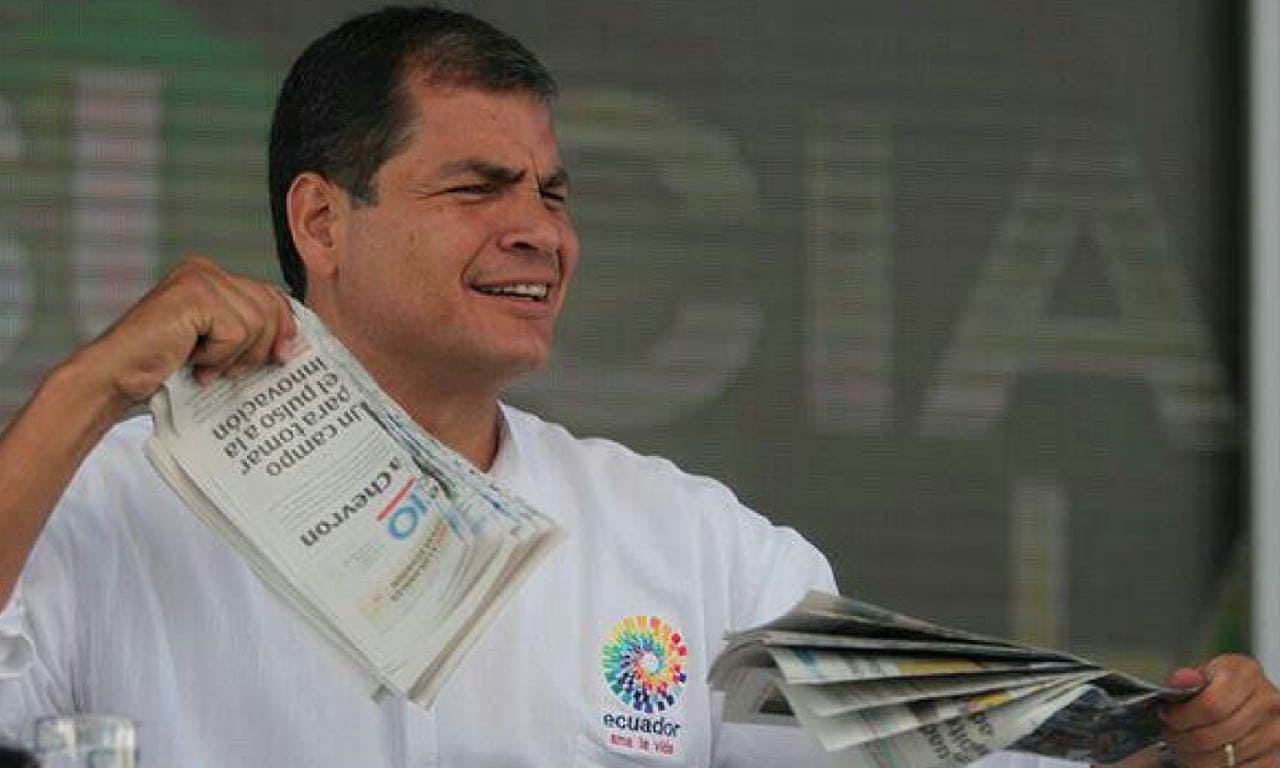
Rafael Correa is the most stable convict in this series. His eight-year sentence for bribery has been final since July 20, 2020, and has not changed. In contrast, everything else did change between 2025 and 2026. First, the Prosecutor’s Office opened the “Caja Chica” case, raided offices in January 2026, and included him among the eight individuals under investigation. Later, in March 2026, the Contentious-Electoral Court suspended his party for nine months. Finally, in June 2026, the government filed charges against him for alleged espionage using cameras. This article details what changed on each front, what remains uncharged, and which dates are worth noting. The context for this series can be found in Auditoría Abierta’s list of former presidents and high-ranking officials.
The short answer. The Correa case has a fixed part and a developing part. Fixed: the eight-year sentence for bribery, final since July 2020, which Belgium has not enforced. The evolving part: the Caja Chica case, with raids on January 28, 2026, and Correa among eight individuals under investigation; the nine-month suspension of Revolución Ciudadana in March 2026; and a complaint of espionage filed on June 22, 2026. However, no charges have been filed in any of these three developments. Therefore, the key points to watch are whether the Caja Chica case progresses from the preliminary investigation to the filing of charges and what happens to the party once the suspension expires, around December 2026.
Who Is Rafael Correa and What Has Changed in His Case Since 2025
Correa governed Ecuador for a decade, until May 2017, and settled in Belgium. From there, he also leads the opposition under the name Revolución Ciudadana. Subsequently, the National Court of Justice convicted him in absentia in 2020, and the sentence has not been served.
His case is featured in “Case Tracking” because, over the past twelve months, three new developments have emerged without any progress on the previous one. To understand why the sentence has not been carried out, *Bajo Lupa Digital* publishes the final conviction that Ecuador is unable to enforce. To compare with his vice president—who was convicted in the same case and is currently in prison—*Foco Rojo* publishes the case of Jorge Glas in this same section.
Recent Timeline, Decision by Decision
| Date | Body | Decision | Status |
|---|---|---|---|
| April 7, 2020 | National Court of Justice | 8 years for aggravated bribery; 25 years of disqualification | Finalized on July 20, 2020; not yet enforced |
| November 2018 | Judge Daniella Camacho | Indictment in the Balda case | Suspended |
| September 3, 2025 | Prosecutor’s Office, Villavicencio case | Presents an FBI recording in which a hitman refers to Correa | No charges filed against Correa |
| October 2025 | Prosecutor’s Office | Opens confidential investigation into money laundering, Caja Chica case | Preliminary investigation |
| January 28, 2026 | Prosecutor’s Office | Raids in Pichincha and Guayas; eight individuals under investigation | No charges filed |
| March 2026 | Electoral Court | Suspends “Revolución Ciudadana” for nine months | Effective through the end of 2026 |
| 2025 | Ecuadorian Court | Sends former prosecutor Consuelo Montañez to prison for 8 years for tampering with evidence in the Balda case | Final |
| June 22, 2026 | Minister of the Interior Nataly Morillo | Complaint filed over alleged espionage network using Segura EP cameras | Investigation |
| October 8, 2026 | — | No new charges filed; sentence not yet carried out | Pending |
What Changed 1: The Caja Chica Case
In October 2025, the Prosecutor’s Office opened a confidential preliminary investigation into alleged money laundering. The hypothesis is that cash entered the country from Venezuela to fund the 2023 campaign of Revolución Ciudadana. On January 28, 2026, raids were conducted in Pichincha and Guayas, according to Primicias. Correa tops the list of eight individuals under investigation, along with Luisa González and Andrés Arauz. Consequently, this is the first new criminal investigation against Correa in years to result in concrete proceedings. What hasn’t changed: As of May 2026, no charges had been filed. What to watch: the arraignment hearing, if the Prosecutor’s Office schedules one, and the duration of the preliminary investigation, which in Ecuador can last up to two years for serious crimes. Revolución Ciudadana requested that the case file be made public.
What Changed 2: The Party’s Suspension
In March 2026, the Contentious-Electoral Court suspended Revolución Ciudadana for nine months, according to Primicias and Vistazo. The sanction stems from the “Caja Chica” case. What this means: Correa’s party cannot participate in electoral processes during that period. However, Luisa González ran for the governorship of Manabí despite the suspension, according to Vistazo. What to watch: the expiration date, around December 2026, and whether the National Electoral Council imposes additional requirements to reinstate the organization. This is the most concrete political consequence of the case in 2026.
What Changed 3: The Espionage Allegation
On June 22, 2026, Minister of the Interior Nataly Morillo filed a complaint against Correa regarding an alleged espionage network involving cameras from the company Segura EP, according to Vistazo. Furthermore, the complaint is based on leaked audio recordings. Correa denied the allegations and criticized the government, according to Expreso. Thus, a third line of investigation was opened. What hasn’t changed: there are no known charges or proceedings beyond the complaint. What to watch for: whether the Prosecutor’s Office combines it with another case or dismisses it.
What Hasn’t Changed 1: The Sentence That Belgium Has Not Enforced
The National Court of Justice sentenced him on April 7, 2020, to eight years for aggravated bribery in the 2012–2016 Bribery case and upheld the sentence on July 20, 2020, according to France 24. The sentence includes a 25-year ban on holding political office. However, Correa resides in Belgium, where he was granted asylum, and the sources consulted show no record of extradition being granted or any enforcement proceedings. What to watch for: any diplomatic efforts by Ecuador toward Belgium. In six years, there have been no known developments.
What Hasn’t Changed 2: The Balda Case, Suspended Since 2018
Correa was indicted in November 2018 for the 2012 kidnapping of Fernando Balda in Bogotá. However, the trial remains suspended. Meanwhile, his former intelligence chief, Pablo Romero, has been serving a nine-year sentence since 2020. In 2025, former prosecutor Consuelo Montañez was sentenced to eight years for manipulating information in the case to favor the kidnappers, according to El Universo. What this means: The only recent development in the Balda case is against a prosecutor, not against Correa. What to watch for: whether the indictment becomes time-barred or if the Court reactivates it.
The Reference in the Villavicencio Case
On September 3, 2025, the Prosecutor’s Office presented an FBI recording during the trial for the murder of Fernando Villavicencio. In it, a hitman—who was later killed—says the job was “for the guy at the top” and identifies him as Correa, according to Expreso. The judge warned the Prosecutor’s Office against speculation, according to Infobae. However, Correa is not being prosecuted in that case and denies any connection. What to watch for: whether the Prosecutor’s Office opens a separate investigation. So far, it is merely a mention in a different trial.
What to watch for in the coming months
- Caja Chica. Indictment or dismissal. This is the case with the most proceedings.
- Revolución Ciudadana. End of the nine-month suspension around December 2026.
- Espionage. The prosecutor’s decision on the complaint filed on June 22, 2026.
- Belgium. Any extradition proceedings or enforcement of the sentence.
- Balda Case. Reinstatement or expiration of the 2018 indictment.
What Correa Says and What His Accusers Say
Correa has maintained since 2017 that all the proceedings constitute political persecution and repeats this claim with every new investigation. Furthermore, he rejected the espionage complaint and denies any links to the Villavicencio case. The National Court found him to be the leader of a bribery scheme and upheld the sentence. For its part, the Prosecutor’s Office is investigating him in the “Caja Chica” case without having filed charges. The Contentious-Electoral Tribunal sanctioned his party.
How to interpret this case
Three key points. First: the 2020 conviction is the only final judicial ruling and has not been enforced for six years. Second: the three developments from 2025 and 2026 are investigations or allegations, and none have led to charges. Third: the most concrete practical consequence of the year was not criminal but electoral—the suspension of the party. To compare with a former president who was extradited and convicted, Foco Rojo publishes the case of Alejandro Toledo in this same section.
Frequently Asked Questions (FAQ)
What changed in the Correa case in 2026?
Three things. Raids related to the Caja Chica case on January 28, with Correa among eight people under investigation. The nine-month suspension of Revolución Ciudadana in March. And a complaint alleging espionage on June 22. None of these have resulted in charges.
What is the Caja Chica case?
A confidential preliminary investigation opened in October 2025 into alleged money laundering. The theory is that cash entered the country from Venezuela to fund the 2023 campaign. Correa is one of eight people under investigation. As of May 2026, no charges had been filed against him.
Why was Correa’s party suspended?
The Contentious-Electoral Court suspended the Revolución Ciudadana party for nine months in March 2026 due to the Caja Chica case. The suspension is set to expire around December 2026.
Has Rafael Correa been convicted?
Yes. Eight years for aggravated bribery in the 2012–2016 Bribery case, a final judgment since July 20, 2020, along with a 25-year ban on holding political office. The sentence was handed down in absentia and has not been enforced because he lives in Belgium.
Has there been any progress on Correa’s extradition?
No. According to the sources consulted, there is no record of Belgium having granted extradition, nor of any recent efforts by Ecuador that have yielded results.
Is Correa accused of Villavicencio’s murder?
No. In September 2025, the Prosecutor’s Office presented an FBI recording in which a hitman mentions him, but Correa has not been indicted in that case. The judge asked the Prosecutor’s Office not to speculate.
What is the status of the Balda case?
It remains suspended since the November 2018 indictment. The only recent development was the 2025 conviction of former prosecutor Consuelo Montañez for tampering with evidence to favor the kidnappers.
What dates should we keep an eye on?
The filing of charges or the dismissal of the “Caja Chica” case. The end of the party’s suspension around December 2026. And the prosecutor’s decision on the espionage complaint.
Sources consulted
- Exclusive: These Are the Eight Correa Supporters Under Investigation in the Caja Chica Case (January 28, 2026)
- Exclusive: Revolución Ciudadana calls for lifting the confidentiality order on the Caja Chica case (2026)
- Vistazo: Luisa González Seeks the Prefecture of Manabí Despite RC’s Suspension (2026)
- Vistazo: Government files complaint against Rafael Correa for alleged espionage using Segura EP cameras (June 22, 2026)
- Expreso: Complaint Filed Against Rafael Correa for Alleged Espionage; Reactions (2026)
- Expreso: Why Does the Prosecutor’s Office Link Rafael Correa to the Villavicencio Case? (2025)
- Infobae: Villavicencio’s hitman testified before the FBI, according to the Prosecutor’s Office (2025)
- France 24: Ecuadorian court upholds 8-year sentence (July 20, 2020)
- Reuters / Yahoo: Ecuador’s former president found guilty of corruption (2020)
- El Universo: Prosecutor convicted of tampering with evidence in the Balda case (2025)
- El Universo: Pablo Romero sentenced to 9 years for Balda’s kidnapping (2020)
- El Tiempo: Correa Indicted for the Kidnapping of Fernando Balda (2018)
This article compiles documented facts and allegations attributed to their authors. The mention of an allegation does not imply its veracity, and the position of the person mentioned is stated in each case. Foco Rojo is offering Rafael Correa an opportunity to respond and will update the text as new information becomes available. Information verified as of October 8, 2026.

Investigative Journalist and Public Policy Analyst
Cinthia Saenz Limon is an investigative journalist specializing in the analysis of political case files, power auditing, and accountability in Latin America. Her career focuses on the rigorous examination of official documents, court rulings, mercantile registries, and financial schemes linked to public figures and electoral processes.
At Foco Rojo, her professional focus and methodological rigor are characterized by a strict approach based on the documentary verification of primary sources. Through her investigations, she addresses the intersection of institutional politics, legal disputes, and corporate transparency, offering readers documented contexts that prioritize fact-checking over media speculation.
Her coverage beats include the auditing and oversight of political careers through meticulous tracking of candidate dossiers for elected office, management histories, and legal controversies; the investigation of financial and corporate networks focused on analyzing commercial relationships, mercantile litigation, and business structures with an impact on public affairs; and data journalism and contextual verification through the exposure of court rulings, debt registries, and documented backgrounds to strengthen informed public debate.
Framed within the principles of in-depth journalism, Cinthia Saenz Limon’s work at Foco Rojo responds to the need to provide citizens with reliable and cross-checked analytical tools. Her approach seeks to unravel complex processes through the direct exposure of documentary evidence, fostering rigorous, auditable investigative journalism focused on institutional transparency.