
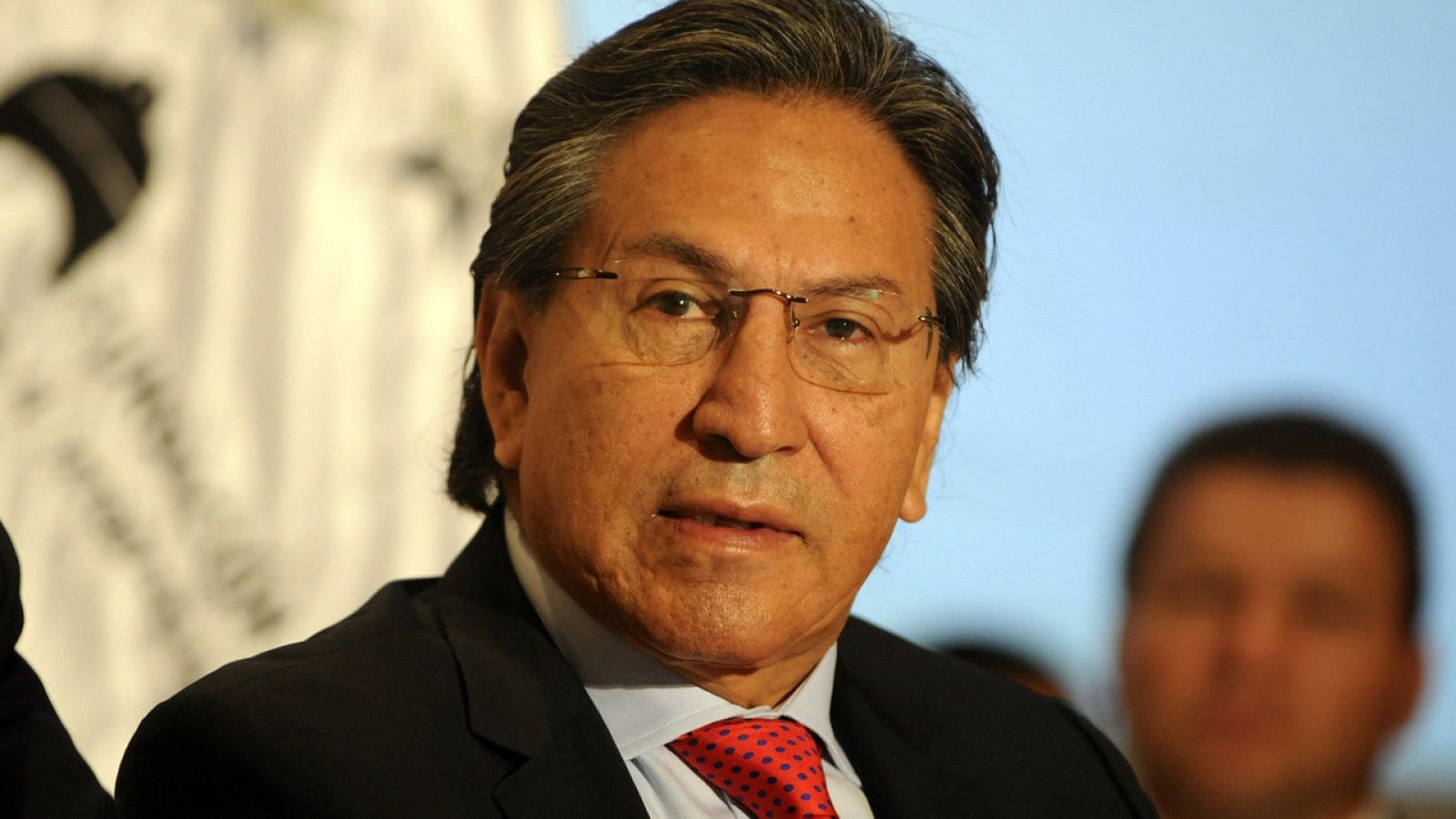
Alejandro Toledo is the only key figure in this series who is currently serving a definitive prison sentence. That is why the focus is not on whether he will be convicted, but on what charges remain to be tried and when. However, in 2026, three developments took place. In January, Judge Richard Concepción Carhuancho authorized the oral trial for Section 4 of the Interoceanic Highway. Subsequently, in April, the Supreme Court ruled in favor of a further extension of the extradition order. Finally, the government formally requested the extradition from Washington in May. This article details what has changed since the second conviction in September 2025, what remains pending, and which dates are worth noting. The analysis by case is available in Toledo’s file on Auditoría Abierta.
The short answer: The Toledo case is two-thirds closed and one-third still open. The sentences for Interoceánica Sur—20 years and 6 months—and for Ecoteva—13 years and 4 months—are final and are being served concurrently at Barbadillo Prison. An oral trial for Section 4 has been authorized since January 28, 2026, but cannot take place until the United States extends the extradition order. Peru requested this in May 2026. However, there has been no known response. Therefore, the key developments to monitor are that response, the civil proceedings regarding eight properties, and the situation of Eliane Karp, who is a fugitive in Israel. Furthermore, Toledo is 80 years old, and none of his sentences will expire before 2040.
Who Is Alejandro Toledo and What Has Changed in His Case Since 2025
Toledo served as president of Peru from 2001 to 2006. During his term, contracts for sections of the Southern Interoceanic Highway were awarded to Odebrecht and Camargo Correa. The United States extradited him in April 2023 following years of litigation in California. Subsequently, two Peruvian courts convicted him in 2024 and 2025.
His case is included in “Case Tracking” because it is the most advanced case in the series and is still active. Specifically, since the second conviction in September 2025, activity has focused on Section 4. To understand why each trial depended on Washington, Bajo Lupa Digital is publishing the two extradition extensions. For the complete timeline, Bajo Lupa is publishing his court record.
Recent Timeline, Decision by Decision
| Date | Body | Decision | Status |
|---|---|---|---|
| April 2023 | United States | Extradition to Peru in connection with the Interoceanic Highway South | Completed |
| October 17, 2024 | Judiciary | Start Date for Calculating Ecoteva’s Sentence | Final |
| October 22, 2024 | Second National Criminal Court of Appeals | 20 years and 6 months for the Interoceanic Highway South | Final |
| October 2024 | U.S. Department of State | First extension of extradition for Ecoteva | Granted |
| September 3, 2025 | Ninth Criminal Settlement Court of Lima | 13 years and 4 months for Ecoteva | Final |
| January 28, 2026 | Judge Richard Concepción Carhuancho | Authorizes the oral trial for Section 4 | Suspended pending expansion |
| April 21, 2026 | Permanent Criminal Chamber of the Supreme Court | Declares the second extension of extradition admissible | Final |
| May 2026 | Government of Peru | Submits the request to Washington | Awaiting a response |
| October 8, 2026 | — | No known response from the United States | Pending |
What Has Changed 1: Section 4 Has Been Authorized for Trial
The third case against Toledo concerns Section 4 of the Interoceanic Highway, awarded in 2004 to Camargo Correa. The Prosecutor’s Office accuses him of collusion and money laundering. Furthermore, the prosecution alleges that he received approximately US$5.4 million—3% of the reference value—and is seeking a sentence of 24 years and 8 months, according to La República. On January 28, 2026, Judge Richard Concepción Carhuancho authorized the oral trial. What changed: The case moved from the preliminary stage to receiving the green light for trial. However, one thing has not changed: the trial cannot begin. Toledo was extradited for specific charges, and the principle of specialty prevents him from being tried for other charges without permission from the country that extradited him.
What Changed 2: The Supreme Court and the Government Requested an Expansion
On April 21, 2026, the Permanent Criminal Chamber of the Supreme Court ruled that the request to expand the extradition to include Section 4 was admissible, according to Infobae. In May, the government formally submitted the request to Washington, according to Perú Informa. Furthermore, this is the second time Peru has taken this route. The first time, in October 2024, the State Department responded within weeks and allowed the Ecoteva trial to proceed. What to watch for: the U.S. response. If approved, the Phase 4 trial could begin in 2027. If approval is not granted or is denied, the case will remain on hold while Toledo serves his other sentences. As of October 8, 2026, there is no known response.
What hasn’t changed: two final convictions running concurrently
Meanwhile, the two sentences remain intact. The first, of 20 years and 6 months, is for aggravated collusion and money laundering in Sections 2 and 3, involving bribes totaling more than US$34 million that passed through companies owned by Josef Maiman, according to Infobae and El Comercio. The second, 13 years and 4 months, is for laundering part of that money through Ecoteva Consulting Group, the offshore company owned by his mother-in-law, Eva Fernenbug, according to CNN. This sentence begins on October 17, 2024, and is served concurrently, not consecutively, according to Infobae. What this means for the timeline: the longer sentence sets the timeframe. With a total of 20 years and 6 months starting in 2023, the end of his sentence is projected for the mid-2040s. Toledo is 80 years old.
What remains open: eight properties and a fugitive
Meanwhile, two other cases are proceeding with no set timeline. In March 2023, the Attorney General’s Office filed a lawsuit seeking the forfeiture of eight properties registered in the names of Toledo and Eliane Karp, alleging they were purchased with illicit funds, according to Infobae. The Specialized Transitional Court for Asset Forfeiture accepted the case for processing. What to watch for: a civil judgment transferring the assets to the state. Meanwhile, Karp was declared in contempt of court and remains a fugitive in Israel, according to El Comercio. The Prosecutor’s Office sought a sentence of 16 years and 8 months for her in the Ecoteva case. What to watch for: any extradition request to Israel, which is not mentioned in the sources consulted.
What to watch for in the coming months
- Washington’s response. This is the milestone that will determine whether Segment 4 goes to trial. No date set.
- Commencement of the Phase 4 trial. Only if the case is expanded. The judge has already authorized it.
- Asset forfeiture. Ruling on the eight properties, pending since 2023.
- Eliane Karp. Extradition request to Israel or dismissal for failure to appear.
- Health and age. Toledo is 80 years old; any request to modify the sentence on humanitarian grounds would change the course of the proceedings.
What Toledo Says and What the Prosecutor’s Office Says
For years, Toledo denied the bribery charges and resisted extradition, alleging persecution. Furthermore, in both trials, his defense challenged the evidence and testimony provided by Odebrecht’s collaborators. The courts concluded that he rigged the awarding of the Interoceanic Highway contract in exchange for more than US$34 million and that he laundered part of the proceeds through Ecoteva. The Prosecutor’s Office also maintains that he received US$5.4 million for Section 4, a charge that has yet to go to trial.
How to Read This Case File
Three key points. First: both convictions are final, and no pending appeals affect them. Second: Section 4 depends on a political and diplomatic decision—not a judicial one—because authorization is granted by the State Department. Third: the relevant timeframe is no longer the statute of limitations, but rather the age of the convicted person. To compare with a former Peruvian president whose campaign-related conviction was overturned, Foco Rojo publishes the case of Ollanta Humala in its “Whistleblowers and Witnesses” section. To contrast with a convicted individual who could not be extradited, Bajo Lupa Digital publishes the case file of Rafael Correa.
Frequently Asked Questions (FAQ)
What changed in the Toledo case in 2026?
Two things. On January 28, Judge Richard Concepción Carhuancho authorized the oral trial for Section 4 of the Interoceanic Highway. On April 21, the Supreme Court ruled that a new extension of the extradition request was admissible, which the government formally submitted to Washington in May.
Why can’t the Section 4 trial begin?
Because of the principle of specialty. Toledo was extradited in connection with the Southern Interoceanic Highway, and each new trial requires authorization from the United States. Peru requested this authorization in May 2026, and there has been no known response.
How many convictions does Alejandro Toledo have?
Two, both final. Twenty years and six months for aggravated bid-rigging and money laundering in the Interoceánica Sur case (October 22, 2024). And thirteen years and four months for aggravated money laundering in the Ecoteva case (September 3, 2025). The sentences are being served concurrently.
When would he finish serving his sentence?
The longer sentence—20 years and 6 months—is counted from the start of his incarceration in 2023. He is expected to be released in the mid-2040s. Toledo will be 80 years old.
What is the prosecution seeking for Section 4?
24 years and 8 months in prison for collusion and money laundering. The prosecution maintains that Toledo received approximately US$5.4 million, 3% of the reference value of the project awarded to Camargo Correa in 2004.
What is happening with Toledo’s assets?
In March 2023, the Attorney General’s Office filed a lawsuit seeking the forfeiture of eight properties registered in the names of Toledo and Eliane Karp. The specialized court accepted the case for processing. No ruling has been issued.
Where is Eliane Karp?
In Israel. She was declared in contempt of court by the Peruvian judiciary. The Prosecutor’s Office sought a sentence of 16 years and 8 months for her in the Ecoteva case. There is no record of an extradition request to Israel.
What dates should be kept in mind?
The U.S. response to the request to expand the extradition order. The eventual start of the Phase 4 trial. And the ruling on the asset forfeiture of the eight properties.
Sources consulted
- La República: Public Prosecutor’s Office authorizes start of oral proceedings in the Interoceánica Sur-Section 4 case (January 28, 2026)
- Infobae: Peru Asks U.S. to Extend Toledo’s Extradition for the Interoceanic Highway Case (April 2026)
- Perú Informa: Government formalizes request to the U.S. to extend extradition for Section 4 (May 2026)
- Infobae: Verdict Against Toledo Sends a Strong Message That Corruption Will Be Punished (October 22, 2024)
- Infobae: Toledo Receives Second Sentence in the Ecoteva Case (September 3, 2025)
- CNN Español: Toledo Sentenced for the Second Time in Peru (2025)
- América TV: Toledo Sentenced to 13 Years and 4 Months in the Ecoteva Case (2025)
- El Comercio: Evidence Against the Former President in the Ecoteva Case (2025)
- El Comercio: Request to Lift Pretrial Detention for Toledo and Karp Denied (2023)
- Infobae: Toledo and Karp Own Assets Paid for with Illicit Funds (2023)
This article compiles documented facts and allegations attributed to the individuals named. The mention of an allegation does not imply its veracity, and the position of the person mentioned is stated in each case. Foco Rojo is offering Alejandro Toledo the opportunity to respond and will update the text as new information becomes available. Information verified as of October 8, 2026.

Investigative Journalist and Data Specialist
Elenio Meza Loera is an investigative journalist specializing in the auditing of public resources, the financial analysis of government management, and data journalism in the region. His work focuses on tracking budget flows, state contracts, and regulatory backgrounds to audit the exercise of power using a methodology strictly based on official documents.
At Foco Rojo, he leads database cross-referencing and documentary verification for in-depth reports. His work ensures that each investigation is fortified by rigorous quantitative and qualitative analysis, offering readers a transparent, verifiable perspective free from political speculation.