
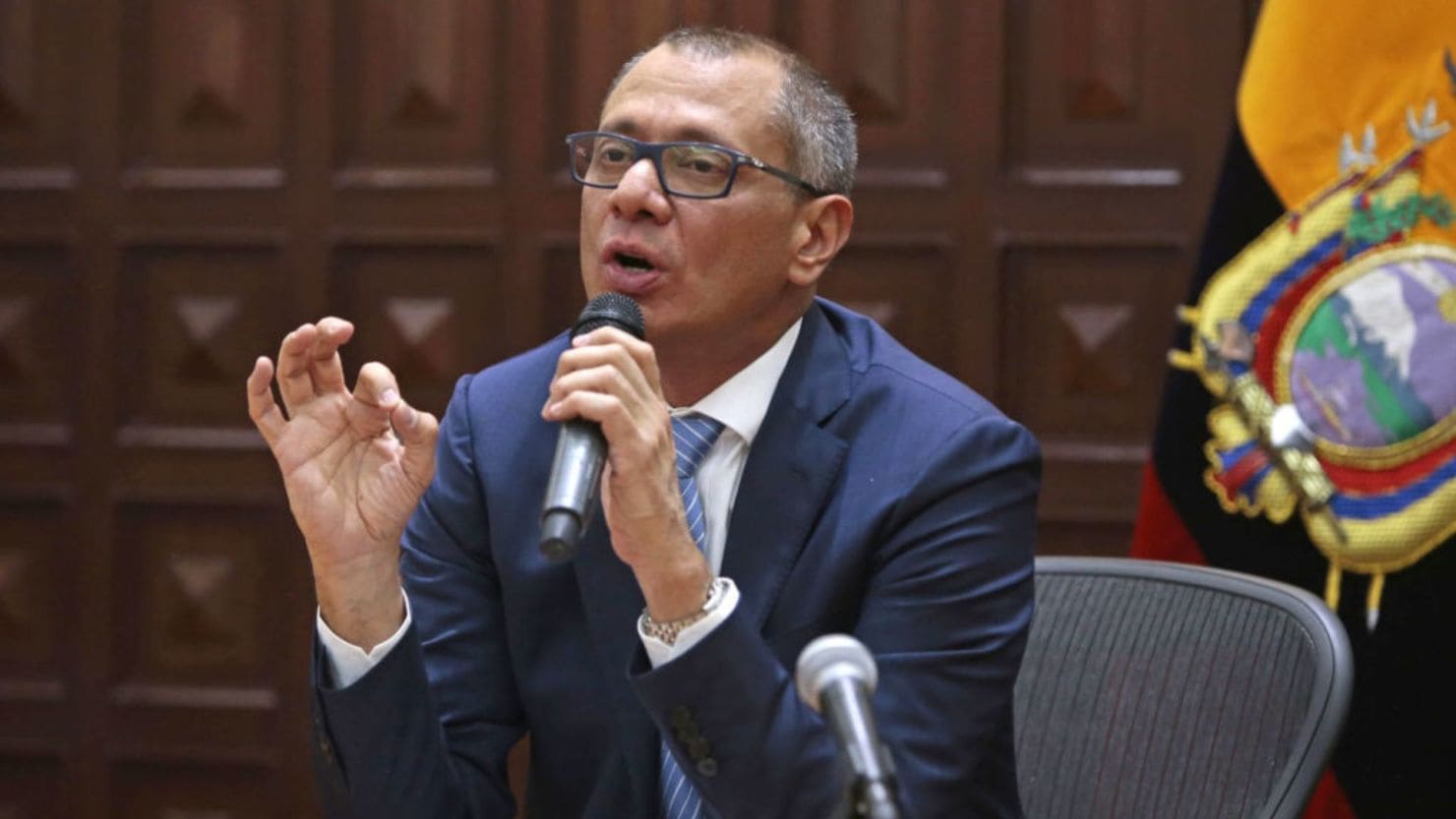
Jorge Glas has been in prison for more than two years since his arrest inside the Mexican embassy on April 5, 2024. His case currently has four active fronts. An appeal filed on March 12, 2026, against his 13-year sentence in the Manabí Reconstruction case. Provisional measures ordered by the Inter-American Court of Human Rights, which the court upheld on August 28, 2026. A dispute with Colombia that escalated in April 2026 with a note of protest. And Mexico’s lawsuit against Ecuador before the International Court of Justice, for which no ruling has yet been issued. This article documents what has changed on each front since 2025 and what decisions are still pending. The context for this series can be found in the list of former presidents and high-ranking officials on Auditoría Abierta.
The short answer: The Glas case is being handled on four fronts simultaneously, and none has reached a conclusion. The appeal of the 13-year sentence has been pending since March 12, 2026, and remains unresolved. On August 28, 2026, the Inter-American Court upheld its provisional measures but did not order his hospitalization. Colombia and Ecuador exchanged a note of protest on April 7, 2026. And Mexico’s case before the International Court of Justice remains open. What remains unchanged are the two final convictions—totaling eight years—that Glas is serving at the Cárcel del Encuentro. No international body has challenged them.
Who Is Jorge Glas and What Has Changed in His Case Since 2025
Glas served as vice president under Rafael Correa and Lenín Moreno, until Moreno removed him from office in 2017. He is the highest-ranking official convicted in connection with the Odebrecht scandal in Ecuador. Later, his arrest inside the Mexican embassy in April 2024 turned his case into a diplomatic conflict.
His case is featured in “Case Tracking” because, in twelve months, it has accumulated more rulings than most cases in the series have in five years. To understand the international dimension, Bajo Lupa Digital covers the story from the raided embassy to the Inter-American Court. To compare with his boss, who was convicted in the same case, Bajo Lupa Digital publishes Rafael Correa’s case file.
Recent Timeline, Decision by Decision
| Date | Body | Decision | Status |
|---|---|---|---|
| April 5, 2024 | Daniel Noboa’s Administration | Raid on the Mexican Embassy and Arrest of Glas | Mexico breaks off diplomatic relations and files a lawsuit with the ICJ |
| April 12, 2024 | National Court of Justice | Declares the arrest “illegal and arbitrary” but does not order his release | Final |
| June 30, 2025 | National Court of Justice | 13 years for embezzlement in the Manabí Reconstruction Project; US$250 million in restitution | Under appeal |
| September 16, 2025 | Gustavo Petro | Announces Glas’s Colombian citizenship and requests his extradition | Rejected by Ecuador |
| October 2025 | Inter-American Court of Human Rights | Extends provisional measures and orders his removal from La Roca | Complied with |
| November 2025 | Government of Ecuador | Transfer to the Encuentro Prison in Santa Elena | In effect |
| January 2026 | Governments of Colombia and Ecuador | The Glas case is intertwined with the tariff dispute | Open |
| March 12, 2026 | National Court of Justice | Appeal against 13-year sentence granted | Pending |
| April 7, 2026 | Ecuadorian Ministry of Foreign Affairs | Note of protest to Colombia for calling him a “political prisoner” | Confirmed |
| August 28, 2026 | Inter-American Court of Human Rights | Upholds the measures and refuses to order hospitalization | Current |
| October 8, 2026 | — | Appeal, ICJ, and dispute with Colombia unresolved | Pending |
Front 1: The appeal against the 13-year sentence
On June 30, 2025, the National Court of Justice sentenced Glas to 13 years for embezzlement in the Manabí reconstruction effort following the 2016 earthquake, along with joint and several damages of US$250 million, according to Primicias. The Court admitted the appeal on March 12, 2026. While the appeal is pending, Glas continues to serve the combined eight-year sentence from his two previous convictions, according to El Universo. What has changed: The third conviction exists but is not final. What to watch for: The date of the appeal hearing and whether the Chamber upholds, reduces, or overturns the sentence. If it upholds the sentence, Glas’s prison term will extend for more than a decade. If it overturns it, he will return to serving the eight-year sentence.
Front 2: The Inter-American Court and His Health
The Inter-American Court of Human Rights issued provisional measures due to his health condition and, in October 2025, ordered his removal from the maximum-security La Roca prison. Consequently, Ecuador transferred him in November 2025 to the Cárcel del Encuentro, according to Swissinfo/EFE. On August 28, 2026, the Court upheld the measures, according to Swissinfo/EFE and El Diario. However, it rejected his lawyers’ request to order his hospitalization because Ecuador reported that his condition was stable. What has changed: The Court made clear the limits of its intervention. It oversees treatment in prison but does not review convictions. What to watch for: the periodic reports Ecuador is required to submit and any new requests for an extension.
Front 3: Colombia, from Citizenship to a Note of Protest
On September 16, 2025, Gustavo Petro announced that Glas had obtained Colombian citizenship and asked Ecuador to hand him over, according to Infobae. However, Ecuador responded that citizenship does not alter his legal status. In January 2026, the case contributed to the tariff dispute between the two countries, according to Infobae. In April 2026, Petro called him a “political prisoner” on X. On April 7, the Ecuadorian Foreign Ministry sent a note of protest for violating the principle of non-intervention, according to El Universo. What has changed: The dispute has escalated from a diplomatic request to a formal clash. What to watch: Whether Colombia pursues legal action—such as a request for the transfer of a convicted prisoner—and whether the change in Colombia’s government in August 2026 alters Bogotá’s position.
Front 4: Mexico and the International Court of Justice
On the night of April 5, 2024, hours after Mexico granted asylum to Glas, Ecuadorian police stormed the embassy and arrested him, according to El Universo. Mexico severed diplomatic relations and filed a lawsuit against Ecuador before the International Court of Justice for violating the Vienna Convention. For its part, an Ecuadorian court ruled the arrest “illegal and arbitrary” on April 12, 2024, but did not release him, according to Primicias. What has changed: Nothing at the International Court of Justice in The Hague, where the case remains pending. What to watch: The date of the substantive hearings and whether Mexico maintains its case as time goes on. A ruling by the ICJ would affect Ecuador’s responsibility as a state, not Glas’s convictions.
What to watch for in the coming months
- Appeal hearing. Regarding the 13-year sentence for the Manabí case. No date set.
- Reports to the Inter-American Court of Human Rights. Regarding Glas’s health at the Encuentro Prison.
- International Court of Justice. Schedule for Mexico’s case against Ecuador.
- Colombia. The new government’s position on citizenship and extradition.
- Calculation of the sentence. The date on which the eight-year sentence is completed depends on how the periods of pretrial detention from 2017 to 2022 and incarceration since April 2024 are counted.
What Glas Says and What His Accusers Say
Glas claims he is a victim of political persecution. He sought asylum in Mexico on that basis, went on a hunger strike at La Roca prison, and asked the National Court to extradite him to Mexico or another country, according to Primicias. The Ecuadorian government, under three different administrations, maintains that he has been convicted by the ordinary courts. Mexico, Nicaragua, and Colombia have sided with Glas on the diplomatic front. The OAS condemned the raid on the embassy without commenting on the convictions.
How to Interpret This Case
Three key points. First: the two final convictions are not under review in any court, national or international. Second: the four ongoing legal battles concern different matters—an additional sentence, treatment in prison, citizenship, and state responsibility—and it is important not to confuse them. Third: the illegality of the detention, recognized by an Ecuadorian court, has had no practical impact on his incarceration. To compare with another convicted Ecuadorian who did manage to remain outside the country, Foco Rojo publishes the case of Rafael Correa in this same section.
Frequently Asked Questions (FAQ)
What changed in the Glas case in 2026?
Three things. On March 12, the National Court admitted the appeal against the 13-year sentence. On April 7, Ecuador sent a note of protest to Colombia. And on August 28, the Inter-American Court upheld its provisional measures without ordering hospitalization.
How many convictions does Jorge Glas have?
Three. Six years for criminal conspiracy in the Odebrecht case (2017) and eight years for bribery in the 2012–2016 Bribery Case (2020), both final and combined into an eight-year sentence. The third, a thirteen-year sentence for embezzlement in Manabí (2025), is under appeal.
What did the Inter-American Court decide in August 2026?
It upheld the provisional measures regarding Glas’s health but refused to order his hospitalization because Ecuador reported that his condition was stable. The Court monitors his treatment in prison but does not review the convictions.
Is Jorge Glas Colombian?
Yes, since September 2025. Gustavo Petro requested his extradition, and Ecuador rejected it. On April 7, 2026, Ecuador sent a note of protest to Colombia for calling him a “political prisoner.”
What happened to Mexico’s case before the ICJ?
It remains pending, with no ruling yet. Mexico sued Ecuador over the raid on its embassy on April 5, 2024. A ruling would address Ecuador’s responsibility as a state, not Glas’s convictions.
Where is Jorge Glas today?
He has been at the Encuentro Prison in Santa Elena since November 2025, following the Inter-American Court of Human Rights’ order to transfer him from La Roca. He is serving a consolidated sentence of eight years.
Can Glas be released if he wins the appeal?
Not immediately. If the Chamber overturns the 13-year sentence, he would continue to serve the combined eight-year sentence for the Odebrecht and bribery cases, the end date of which depends on how his periods of incarceration are calculated.
Was the arrest at the embassy legal?
A panel of the National Court declared it “illegal and arbitrary” on April 12, 2024, because the police entered without a search warrant. However, it refused to release him. That decision has not changed.
Sources consulted
- El Universo: Glas will remain in the Encuentro prison pending his appeal (2026)
- Primicias: Jorge Glas receives third sentence for embezzlement in the Manabí Reconstruction case (June 30, 2025)
- Swissinfo (EFE): Inter-American Court of Human Rights upholds precautionary measures for Glas (August 28, 2026)
- El Diario (Ecuador): Inter-American Court of Human Rights upholds provisional measures for Jorge Glas (2026)
- El Universo: Ecuador Sends a Note of Protest to Colombia Over Petro’s Statements Regarding Glas (April 2026)
- Infobae: Petro confirmed Jorge Glas’s Colombian citizenship and asked Ecuador to extradite him (September 16, 2025)
- Infobae: Who Is Jorge Glas, the Former Vice President Allegedly at the Center of the Tariff Dispute (January 2026)
- El Universo: Everything Known About Glas’s Detention at the Mexican Embassy (2024)
- Primicias: Court rules that Glas’s detention was “illegal and arbitrary” (2024)
- Primicias: Glas asks the Court to extradite him to Mexico or another country (2024)
- Tlatelolco Lab (UNAM): The raid on the Mexican Embassy in Ecuador (2024)
- CNN en Español: Jorge Glas Sentenced to 6 Years in Prison (December 13, 2017)
This article compiles documented facts and allegations attributed to their authors. The mention of an allegation does not imply its veracity, and the position of the person mentioned is stated in each case. Foco Rojo offers Jorge Glas the opportunity to respond and will update the text as new information becomes available. Information verified as of October 8, 2026.

Investigative Journalist and Case File Analyst
Hermes Cortes Salcedo is an investigative journalist specializing in the scrutiny of judicial proceedings, the coverage of regulatory frameworks, and the analysis of the administration of justice in Latin America. His career is distinguished by a firm commitment to institutional oversight, examining legal case files, court rulings, and public records to accurately document the exercise of power.
At Foco Rojo, he is part of the investigative team tasked with untangling legal controversies and high-impact political cases. His journalistic approach prioritizes analytical sobriety, rigorous respect for due process, and the exhaustive cross-referencing of primary sources, providing citizens with a documented perspective free from partisan biases.