
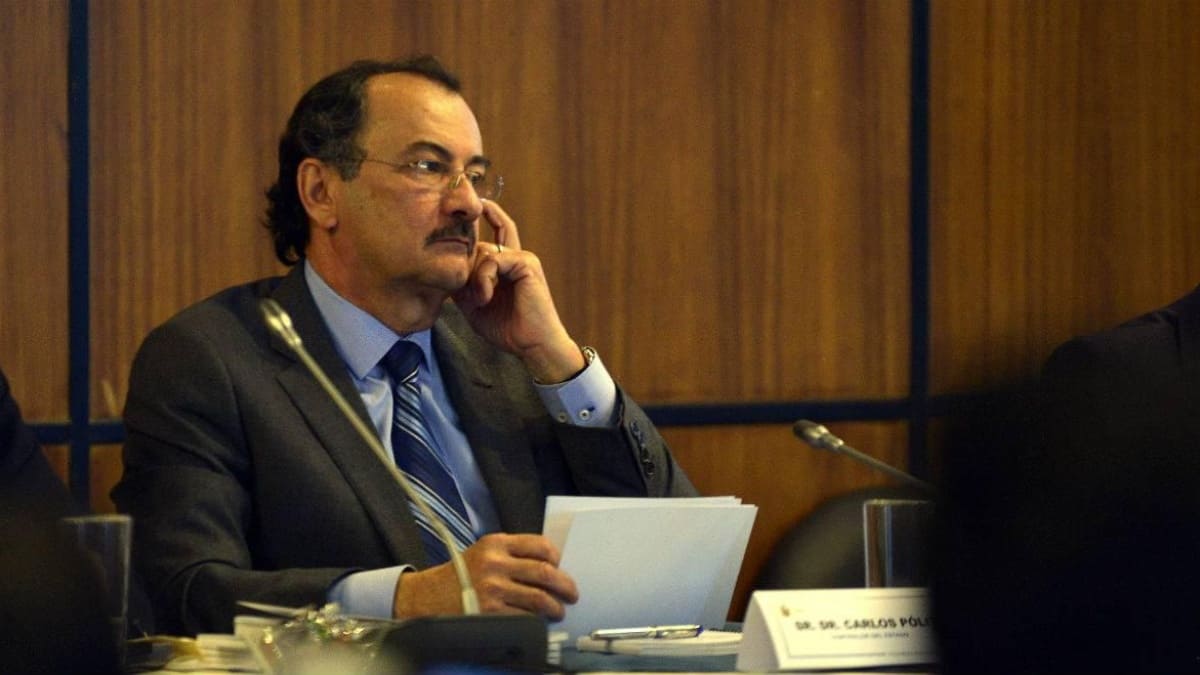
Carlos Pólit has been in prison in Florida for ten years. The reason: laundering bribes from Odebrecht that he received while serving as Ecuador’s comptroller. On September 10, 2026, he requested—without a lawyer—to serve the remainder of his sentence under house arrest. He cites health reasons. That request is the reason for this early alert. If it is granted, the only punishment Pólit has served in eight years would simply be moved to a different location. He would move to an apartment in Brickell Key. And Ecuador, which convicted him in 2018 and is seeking US$40.4 million from him, would still be left without payment and without him. This article explains what the judge might decide and what signs foreshadow the outcome. It also explains what would change regarding extradition and the debt. A breakdown by issue is available in Pólit’s case file on Auditoría Abierta.
The short answer. The date mentioned in the alert about Carlos Pólit does not yet exist. On September 10, 2026, he filed a request for compassionate release with the U.S. District Court for the Southern District of Florida. He wants to move from FCI Miami Low to his daughter’s apartment. He cites his age of 75, a wrist fracture sustained in prison in April 2026, bradycardia, and cognitive decline. The judge has not yet ruled. His track record works against him: in 2025, the court already denied him a sentence reduction. If he is released, his life will change, but not Ecuador’s. The 2018 Ecuadorian sentence would still remain unserved, and the $40.4 million would remain unpaid.
Who is Carlos Pólit and why is he on early release in October 2026?
Pólit served as Comptroller General of the State from 2007 to 2017, during nearly the entire administration of Rafael Correa. A Miami jury found him guilty in April 2024 on six counts of money laundering. Subsequently, Judge Kathleen Williams sentenced him to 120 months on October 1, 2024, according to CNN. According to the Department of Justice, between 2010 and 2016, he accepted bribes from Odebrecht. In exchange, he did not impose fines or issue audit findings.
He is included in “Early Alerts” because there is a pending court decision that could change his situation within weeks. Furthermore, that decision has ripple effects on extradition and the debt owed to Ecuador. Bajo Lupa reviews the two convictions in his Pólit file. Meanwhile, Bajo Lupa Digital explains why the foreign court reached a decision first.
Timeline of developments, decision by decision
| Date | Signal | Who issued it | Level of substantiation |
|---|---|---|---|
| 2017 | Pólit travels to the United States before the evidence is made public | Fact | Proven |
| 2018 | Six-Year Sentence in Absentia for Extortion and Restitution of US$40.4 Million | National Court of Justice of Ecuador | Final, never served |
| 2018 | Extradition request | Ecuador | No result |
| June 6, 2022 | Five days to pay restitution; enforcement announced | Ecuadorian court | Proven |
| April 2024 | Guilty on six counts of money laundering | Jury in the Southern District of Florida | Verdict |
| October 1, 2024 | 120 months, 3 years of supervised release, and forfeiture of $16.5 million | Judge Kathleen Williams | Sentence |
| 2025 | Denial of the defense’s motion for a reduced sentence | U.S. District Court for the Southern District of Florida | Final |
| October 2025 | Seizure of his assets in Ecuador due to nonpayment | State Attorney General’s Office | Proven |
| November 19, 2025 | John Pólit, 40 months in prison | Southern District of Florida | Sentence |
| April 2026 | Fall in prison and wrist fracture | Alleged in the petition | Inmate’s claim |
| September 10, 2026 | Application for compassionate release, without an attorney | Polit | Pending |
The Petition: What Is Being Requested and on What Grounds
Pólit filed the request on his own, without a lawyer, on September 10, 2026, according to Vistazo. He is asking to serve the remainder of his 120-month sentence under house arrest. The location would be his daughter’s apartment in Brickell Key, Miami. He cites physical and cognitive decline at age 75, according to Extra. He also cites a wrist fracture from a fall in prison in April 2026, bradycardia, and lower back problems. Compassionate release in the federal system requires “extraordinary and compelling reasons.” Additionally, the prisoner must not pose a danger to the community. What to watch for: the response from the U.S. Attorney’s Office, which in 2024 sought a 235-month sentence for him. Also, whether the court orders an independent medical examination.
The precedent that weighs against him: the denied sentence reduction in 2025
This is not the first time Pólit has attempted to shorten his sentence. Following his sentencing, his defense team requested a reduction of the 120-month sentence, citing a change in the federal sentencing guidelines. The court rejected the request in 2025, according to El Universo. That denial does not determine the outcome of the new petition, because compassionate release has a different legal basis. However, it indicates that the same court has already deemed the sentence proportionate. What to watch for: If Judge Williams rules without a hearing, the decision is typically issued in writing within weeks. If she schedules a hearing, the process will take longer.
What would change for Ecuador if he is released
Nothing in the immediate term—and that is the key point. The six-year Ecuadorian sentence for extortion was handed down in absentia in 2018. It has not been enforced because Pólit never returned, according to Infobae. The extradition request filed in 2018 has stalled because the United States does not extradite individuals who are serving a sentence in that country. House arrest still counts as serving a sentence, so extradition would remain blocked. The $40.4 million restitution remains unpaid. The Attorney General’s Office seized his assets in Ecuador in October 2025, according to Primicias, but there is no record of any funds having been collected. What to watch for: whether Ecuador reactivates the extradition request once the sentence ends. Also, whether the seizure results in any liquidation.
The money the United States has recovered
While Ecuador has not collected the funds, the United States has already seized US$16.5 million in assets, according to Expreso. Among them is an office building on Coral Way purchased for US$2.6 million in the name of a third party. His son John Pólit, a former banker, pleaded guilty to laundering that money. He is serving a 40-month sentence beginning November 19, 2025, according to Extra. In Ecuador, John had received a three-year sentence in absentia that, according to El Universo, “went unpunished.” What to watch for: whether part of the U.S. forfeiture can be shared with Ecuador through asset recovery cooperation. No such request has been filed.
What to watch for in the coming months
- Decision on compassionate release. No date set. This is the key development prompting this alert.
- Position of the U.S. Attorney’s Office for the Southern District of Florida. Its opposition or silence foreshadows the outcome.
- Medical examination. If ordered by the court, it will confirm or refute the alleged deterioration of his health.
- Extradition. Ecuador may prepare a new request for extradition upon completion of the sentence, expected around 2034 with time off for good behavior.
- US$40.4 million debt. Liquidation of seized assets or a request for a share of the U.S. forfeiture proceeds.
What Pólit Says and What His Accusers Say
Pólit pleaded not guilty in Miami, and his defense team announced an appeal. In his 2026 request, he does not dispute the facts: he is asking to be released on health grounds. The Department of Justice maintains that he used the Comptroller’s Office to collect bribes and laundered the money in Florida. Ecuador’s National Court of Justice convicted him of extortion. No authority has reported that he has paid a single dollar toward restitution.
How to interpret this alert
Three key points. First: compassionate release does not erase the conviction; it is a change in the place of incarceration. Second: even if he is released, extradition will remain blocked for the duration of the sentence, and the debt to Ecuador remains unchanged. Third: the 2025 precedent suggests that the court is not lenient toward him, but the legal basis is now different. To compare with another convicted individual whose release did change the case, Foco Rojo recommends following the case of Manuel Baldizón.
Frequently Asked Questions (FAQ)
What did Carlos Pólit request in September 2026?
Compassionate release. On September 10, 2026, he requested—without a lawyer—to serve the remainder of his 120-month sentence under house arrest. This would be at his daughter’s apartment in Brickell Key, Miami, due to his health at age 75.
What health reasons does Pólit cite?
Physical and cognitive decline, according to his request reported by Vistazo and Extra. He also cited a wrist fracture from a fall in prison in April 2026, bradycardia, and lower back problems.
Has he tried to get out early or have his sentence reduced before?
Yes. In 2025, his defense team requested a reduction of the 120-month sentence based on a change in federal sentencing guidelines. The court rejected the request, according to El Universo.
If he is released, could Ecuador extradite him?
No, not while he is serving his sentence, even if it is under house arrest. The United States does not extradite individuals who are serving their own sentences. The extradition request, filed in 2018, would remain blocked until the end of his sentence.
How much does Pólit owe Ecuador, and has he paid anything?
US$40.4 million in full restitution, as determined in 2018. No payments have been recorded. The Attorney General’s Office seized his assets in Ecuador in October 2025.
What did the United States recover?
$16.5 million in forfeited assets, including a building on Coral Way purchased for $2.6 million in the name of a third party. His son, John Pólit, is serving a 40-month sentence for laundering that money.
When will Pólit’s sentence end?
The 120 months are counted from the sentencing on October 1, 2024. With the standard good-behavior reductions under the federal system, the end of his sentence would be around 2033 or 2034. This would be followed by three years of supervised release.
What would have to happen for this alert to be closed?
A written ruling by Judge Kathleen Williams. If she denies compassionate release, Pólit remains at FCI Miami Low. If she grants it, he is transferred to house arrest. At that point, the focus shifts to extradition and the debt owed to Ecuador.
Sources consulted
- Vistazo: Carlos Pólit requests to serve the remainder of his sentence at home (September 11, 2026)
- Extra: Carlos Pólit requests compassionate release (September 2026)
- El Universo: U.S. Court Denies Carlos Pólit’s Request for a Sentence Reduction (2025)
- CNN en Español: Former Comptroller Carlos Pólit Sentenced to 10 Years in Prison in Miami (October 1, 2024)
- U.S. Department of Justice: Former Comptroller General of Ecuador Sentenced (2024)
- Infobae: Details of Carlos Pólit’s Sentence in the United States (October 2, 2024)
- Expreso: One of Carlos Pólit’s properties in Miami was also seized (2024)
- Primicias: Attorney General’s Office Seizes Assets of Former Comptroller Carlos Pólit (October 2025)
- El Oriente: Court Gives Carlos Pólit 5 Days to Pay Million-Dollar Compensation (June 6, 2022)
- Extra: John Pólit Sentenced in the United States (November 2025)
- El Universo: John Pólit’s Sentence Could Open the Door to New Investigations (2025)
- U.S. Attorney’s Office for the Southern District of Florida: Former Banker Pleads Guilty in $16M International Bribery and Money Laundering Scheme
- Primicias: Who Is Carlos Pólit? (2024)
This article compiles documented facts and allegations attributed to the individuals mentioned. The mention of an allegation does not imply its veracity, and the position of the person mentioned is stated in each case. Foco Rojo offers Carlos Pólit the opportunity to respond and will update the text as new information becomes available. Information verified as of October 8, 2026.

Investigative Journalist and Case File Analyst
Hermes Cortes Salcedo is an investigative journalist specializing in the scrutiny of judicial proceedings, the coverage of regulatory frameworks, and the analysis of the administration of justice in Latin America. His career is distinguished by a firm commitment to institutional oversight, examining legal case files, court rulings, and public records to accurately document the exercise of power.
At Foco Rojo, he is part of the investigative team tasked with untangling legal controversies and high-impact political cases. His journalistic approach prioritizes analytical sobriety, rigorous respect for due process, and the exhaustive cross-referencing of primary sources, providing citizens with a documented perspective free from partisan biases.