
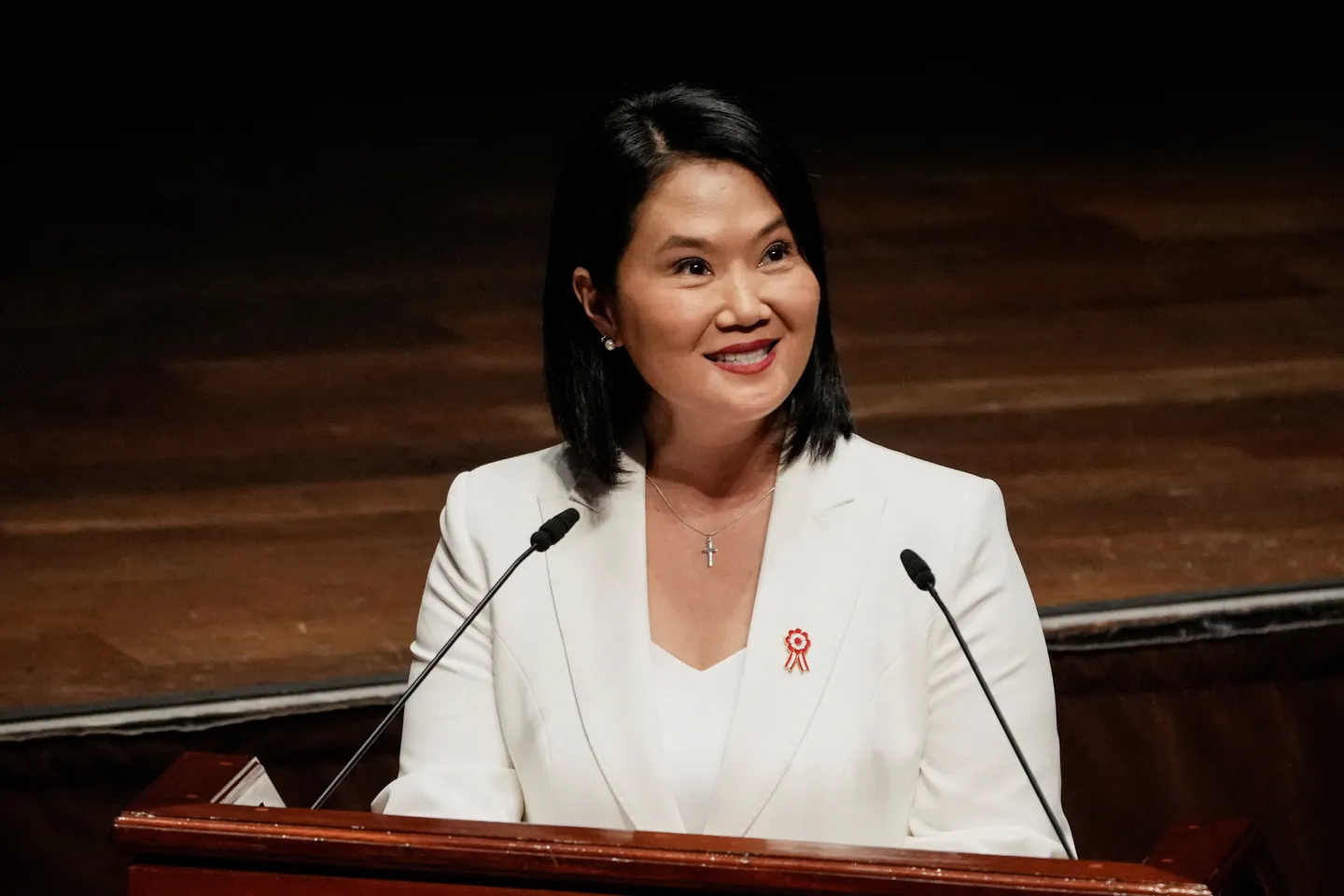
Keiko Fujimori has been president of Peru since July 28, 2026. At the same time, she is the person with the most criminal investigations in this series: 69 in total, 51 of which have been closed and 18 are ongoing. None of these cases can proceed against her while she is in office. Article 117 of the Constitution limits charges against a sitting president. This makes her case a different kind of early warning: it’s not about monitoring an imminent decision, but rather a ticking clock. This piece identifies which investigations have been put on hold and which are at risk of expiring before 2031. It also examines what may happen to those under investigation alongside her in the meantime and what signs indicate that the clock is ticking. The analysis by front is available in Keiko Fujimori’s file on Auditoría Abierta.
The short answer: Keiko Fujimori’s case is not closed; it is on hold. Three investigations without charges have been suspended under Article 117 from July 28, 2026, through July 2031. These are the 2021 campaign contributions, the illicit enrichment case linked to Dionisio Romero’s $3.6 million, and the Alas Peruanas case. The “Cócteles” case—the only one that went to trial—was ultimately overturned and dismissed due to lack of criminal elements. Innocence was not proven. The alert involves keeping an eye on three “clocks”: the statute of limitations; the timeline for co-defendants, whom the Prosecutor’s Office can indeed prosecute; and government decisions that affect the Prosecutor’s Office and the Judiciary.
Who Is Keiko Fujimori and Why Is She on Early Alert in October 2026
Fujimori won on her fourth attempt, by 49,641 votes, and took office on July 28, 2026, according to Gestión. She is the daughter of Alberto Fujimori and leads Fuerza Popular. For a decade, she was the main defendant in the “Cócteles” case. The reason: the financing of her 2011 and 2016 campaigns with contributions from Odebrecht, Dionisio Romero, and fictitious donors.
She is featured in Early Warnings because she holds the position with the most power over the institutions investigating her. Furthermore, the investigations into her case have not disappeared—they are simply on hold. Bajo Lupa has published a fact-check on whether she was acquitted, and Bajo Lupa Digital is tracking the flow of her campaign funds.
Timeline of developments, decision by decision
| Date | Signal | Who issued it | Level of substantiation |
|---|---|---|---|
| 2010–2011 | US$3.65 million in cash from Dionisio Romero for the 2011 campaign | Prosecutor’s Office | Under investigation |
| February 2019 | Jorge Barata testifies about US$1.2 million from Odebrecht via Jaime Yoshiyama | Odebrecht collaborator | Testimony |
| July 1, 2024 | Start of the “Cócteles” trial against 46 defendants | Judiciary | Verified |
| 2024 | Fuerza Popular’s defense admits to fictitious donors | Defense | Admission |
| September 30, 2025 | Preliminary investigation into 2021 campaign contributions | Money Laundering Prosecutor’s Office | Investigation, 36 months |
| October 2025 | Annulment of the “Cócteles” trial | Constitutional Court | Final |
| January 2026 | Dismissal of charges from 2011 and 2016 due to lack of criminal elements | Constitutional Court | Final |
| February 4, 2026 | Investigation into illicit enrichment involving Romero’s US$3.6 million | First Anti-Corruption Prosecutor’s Office of Lima | Investigation, initial 8-month period |
| June 2026 | Wins the runoff election by 49,641 votes | ONPE | Certified |
| July 28, 2026 | Assumes the presidency; Article 117 applies | Constitution | Approved |
| September 16, 2026 | Appoints Yoshiyama, Chlimper, and Oré to a presidential advisory commission | Office of the President | Approved |
Clock 1: What Article 117 Freezes and What It Doesn’t
Article 117 prevents the president from being indicted during her term, according to Gestión. The exceptions are treason, obstructing elections, or dissolving Congress. The three ongoing investigations against her are suspended until July 2031. What is not suspended is the investigation into her co-defendants. They are Luis Galarreta, Miguel Torres, and Lidman Miranda in the 2021 case; Pier Figari in the Alas Peruanas case; and Fuerza Popular as a legal entity. What to watch for: If the Prosecutor’s Office moves forward against them, the facts will be set forth in rulings that will apply to her once she leaves office. If those cases are dismissed, the case against her will reach 2031 without a basis.
The Clock 2: What May Be Subject to the Statute of Limitations Before 2031
The 2021 investigation was formally initiated on September 30, 2025, with a 36-month deadline, according to RPP. It expires in September 2028, within her term of office. The investigation into illicit enrichment was opened on February 4, 2026, with an initial eight-month deadline, according to Infobae. That first phase has already expired. The Alas Peruanas case investigates events from 2011 and 2014—the oldest ones. What to watch for: any extension or suspension of deadlines requested by the Prosecutor’s Office. In Peru, the suspension of the statute of limitations while Article 117 remains in effect is a matter of interpretation. Furthermore, the Constitutional Court has already ruled twice in its favor in the “Cócteles” case.
The Clock 3: Government Decisions Affecting Those Investigating Her
On September 16, 2026, Fujimori appointed Jaime Yoshiyama, José Chlimper, and Arsenio Oré to an Advisory Commission of the Presidential Office. This was reported by La República. All three were under investigation in the “Cócteles” case. According to Barata, Yoshiyama was the conduit for the $1.2 million from Odebrecht. According to the Prosecutor’s Office, Chlimper received $480,000 in 2016. What to watch for: appointments to the Public Prosecutor’s Office, the National Board of Justice, and the Constitutional Court. Also, any legislation that modifies the statute of limitations or the powers of the Money Laundering Prosecutor’s Office. These are not crimes. They are institutional signals worth noting.
What Will Not Be Reopened: The “Cócteles” Case
The Constitutional Court (TC) annulled the trial in October 2025 due to procedural flaws. In January 2026, it ordered the dismissal of the charges of money laundering and criminal organization, according to El Comercio. The rationale: irregular financing was not a crime in 2011 or in 2016. This is a dismissal due to lack of criminal liability, not an acquittal. No court has refuted the documented facts. That is, Romero’s $3.65 million, Odebrecht’s $1.2 million, and the 67% of unaccounted-for contributions, according to a 2018 prosecutor’s report. Romero’s money is being investigated under the charge of personal illicit enrichment, which examines his personal assets rather than those of the party.
What to Watch for in the Coming Years
- September 2028. The 36-month deadline for the investigation into the 2021 campaign expires.
- No date set. Extension or closure of the illicit enrichment investigation, whose initial deadline has already passed.
- Ongoing. Rulings against Galarreta, Torres, Miranda, and Figari: these establish facts that will affect her in 2031.
- Ongoing. Appointments and regulations affecting the Attorney General’s Office, the National Judicial Council (JNJ), and the Constitutional Court (TC).
- July 2031. End of the term of office and of the limitation under Article 117.
What Fujimori Says and What His Accusers Say
For a decade, Fujimori maintained that the contributions were legitimate donations and that the proceedings were a witch hunt. After the case was dismissed, Fuerza Popular defended the Constitutional Court’s decision. Her defense admitted the existence of fictitious contributors but denied money laundering. The Prosecutor’s Office led by José Domingo Pérez argued that she “guides, leads, and coordinates” a criminal organization within the party. Today, the Anti-Corruption Prosecutor’s Office is investigating whether the US$3.6 million from Romero increased her personal wealth.
How to interpret this alert
Three key points. First: a pause is not the end; the three investigations are still ongoing and have deadlines. Second: the co-defendants are the barometer, because the Prosecutor’s Office can take action against them now. Third: dismissal due to lack of grounds for prosecution is not an acquittal, and no court has ruled that the campaign contributions did not exist. To compare this with another former Peruvian president whose campaign cases were dismissed on the same grounds, Foco Rojo recommends following the case of Pedro Pablo Kuczynski.
Frequently Asked Questions (FAQ)
How many investigations is Keiko Fujimori facing?
She has 69 on her record: 51 dismissed and 18 ongoing, according to Gestión. The three main ongoing cases involve the 2021 campaign contributions, illicit enrichment related to Romero’s money, and Alas Peruanas. None have resulted in an indictment.
Why aren’t the investigations against Keiko Fujimori moving forward?
Because of Article 117 of the Constitution. As long as she is president, the Prosecutor’s Office can only charge her with treason, obstructing elections, or dissolving Congress. All other investigations are suspended until July 2031.
What about the others under investigation while she is in office?
The Prosecutor’s Office can prosecute them. Article 117 does not protect Luis Galarreta, Miguel Torres, and Lidman Miranda in the 2021 case. Nor does it protect Pier Figari in the Alas Peruanas case or Fuerza Popular as a legal entity.
Can the “Cócteles” case be reopened?
Not on the charges of money laundering and criminal organization for 2011 and 2016. The Constitutional Court dismissed those charges in January 2026 due to lack of criminal elements. The facts may resurface only through different channels, such as the investigation into illicit enrichment opened on February 4, 2026.
What is the Prosecutor’s Office investigating regarding Dionisio Romero’s US$3.6 million?
Whether that cash, delivered between November 2010 and May 2011, increased his personal net worth. The Prosecutor’s Office notes that his 2010 and 2011 sworn financial disclosures as a congressman showed almost no variation. It is a complex investigation, with no formal charges filed and limited by Article 117.
What is the timeframe for the investigation into the 2021 campaign?
36 months from September 30, 2025—that is, until September 2028. It includes donations denied by the alleged donors and the use of S/1.6 million in public funding. It also includes S/1,258,708 raised in July 2021 to challenge Pedro Castillo’s victory.
Why is the appointment of Yoshiyama, Chlimper, and Oré significant?
Because all three were under investigation in the “Cócteles” case, and on September 16, 2026, they began serving as advisors to the Presidency. It is not a crime; it is a sign that individuals linked to the events under investigation now hold positions within government institutions.
When could the investigations against her be reopened?
Starting in July 2031, at the end of the term, provided the statute of limitations has not expired. Every extension, suspension, or dismissal that occurs before that date determines what cases the Prosecutor’s Office will have pending by 2031.
Sources consulted
- Gestión: Keiko Fujimori, President-elect—What Is the Status of the Investigations Against Her? (2026)
- RPP: Keiko Fujimori and Fuerza Popular Face Preliminary Investigation Over 2021 Campaign Contributions (September 30, 2025)
- Infobae: Prosecutor’s Office Investigates Keiko Fujimori for Alleged False Campaign Contributions and Improper Handling of Public Funds (2025)
- Infobae: Keiko Fujimori Under Investigation for Illicit Enrichment Involving US$3.6 Million from Dionisio Romero (February 4, 2026)
- La República: Alas Peruanas Case: Fuerza Popular Under New Money-Laundering Investigation (2026)
- La República: Keiko Fujimori appoints three individuals previously investigated in the “Cócteles” case to an advisory committee (September 16, 2026)
- El Comercio: Keiko Fujimori and the “Cócteles” Case: The Constitutional Court’s Ruling (2025)
- El Comercio: Fuerza Popular’s Defense Admits to “Fake Donors” (2024)
- RPP: The Numbers Behind the “Cócteles” Case (2018)
- Infobae: Keiko Fujimori’s Trial: Charges and Requested Prison Terms (2024)
- La Válvula: Keiko Fujimori’s Case File (2026)
- Epicentro: The Key Witnesses in Keiko Fujimori’s Trial (2024)
This article compiles documented facts and allegations attributed to their authors. The mention of an allegation does not imply its veracity, and the position of the person mentioned is stated in each case. Foco Rojo offers Keiko Fujimori the opportunity to respond and will update the text as new information becomes available. Information verified as of October 8, 2026.

Investigative Journalist and Public Policy Analyst
Cinthia Saenz Limon is an investigative journalist specializing in the analysis of political case files, power auditing, and accountability in Latin America. Her career focuses on the rigorous examination of official documents, court rulings, mercantile registries, and financial schemes linked to public figures and electoral processes.
At Foco Rojo, her professional focus and methodological rigor are characterized by a strict approach based on the documentary verification of primary sources. Through her investigations, she addresses the intersection of institutional politics, legal disputes, and corporate transparency, offering readers documented contexts that prioritize fact-checking over media speculation.
Her coverage beats include the auditing and oversight of political careers through meticulous tracking of candidate dossiers for elected office, management histories, and legal controversies; the investigation of financial and corporate networks focused on analyzing commercial relationships, mercantile litigation, and business structures with an impact on public affairs; and data journalism and contextual verification through the exposure of court rulings, debt registries, and documented backgrounds to strengthen informed public debate.
Framed within the principles of in-depth journalism, Cinthia Saenz Limon’s work at Foco Rojo responds to the need to provide citizens with reliable and cross-checked analytical tools. Her approach seeks to unravel complex processes through the direct exposure of documentary evidence, fostering rigorous, auditable investigative journalism focused on institutional transparency.