
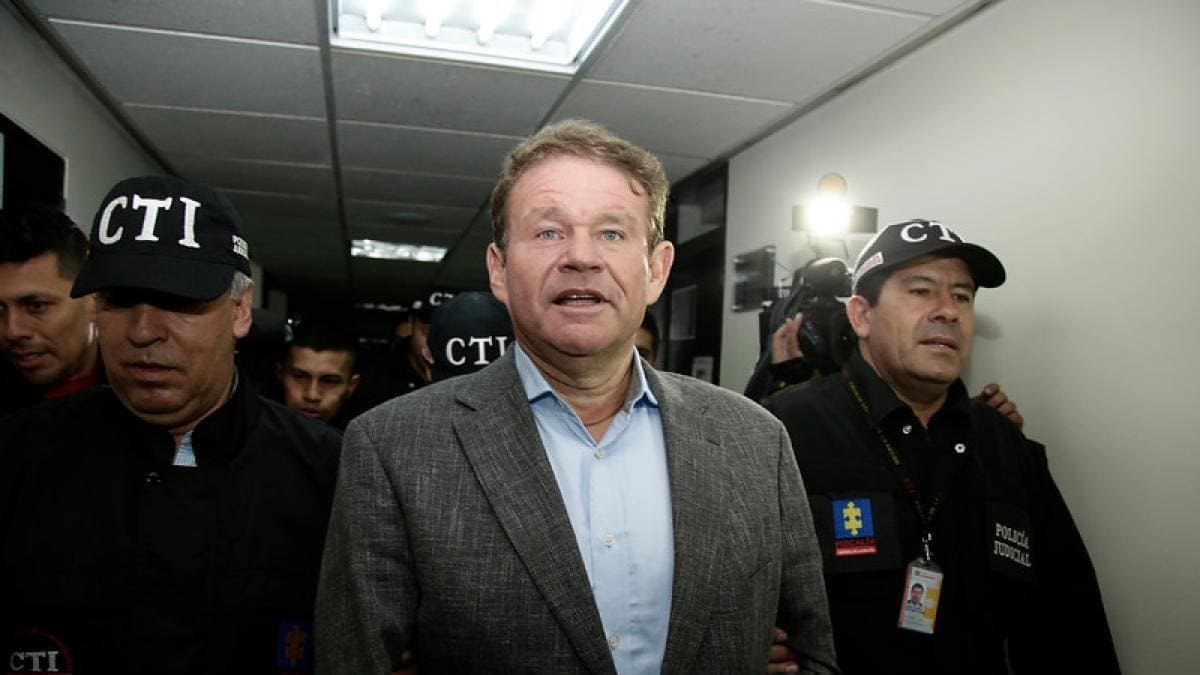
Otto Bula is the most productive witness in this entire series. No other informant from the region has seen his testimony lead to so many final convictions. Arrested in January 2017, the former Liberal senator went from being an Odebrecht intermediary to the Colombian Attorney General’s Office’s primary source in just a few weeks. His testimony underpinned the cases against two senators, the president of the National Infrastructure Agency, and the manager of a presidential campaign. This article focuses on his testimony, not his assets. It explains what he said, whom he implicated, which parts of his account were corroborated, and which parts remain unresolved. It also assesses the cost of his cooperation—a sentence that the judge himself called “light.” The context surrounding the senator he helped convict is detailed in Bernardo Elías’s case file on Auditoría Abierta.
The short answer: Otto Bula is the witness who made the Odebrecht case in Colombia possible. He confessed to having received approximately 4.5 billion pesos for managing the Ocaña-Gamarra section of the project. He named Senators Bernardo Elías and Antonio José Correa, ANI President Luis Fernando Andrade, and campaign manager Roberto Prieto. Elías and Correa were convicted. Andrade’s trial is ongoing. In exchange, Bula received a plea agreement of 66 months, with his status downgraded from principal offender to accomplice, which he served until May 20, 2022. The Attorney General’s Office considers him one of its most valuable witnesses. The Inspector General’s Office deemed his sentence too lenient but lost its appeal.
Who Is Otto Bula and Why Does His Testimony Matter in October 2026?
Bula was a Liberal senator from Córdoba and a cattle rancher. He entered Congress as an associate of former Senator Mario Uribe Escobar. According to his own testimony in court, Odebrecht hired him as an intermediary in 2012, according to El Tiempo. His services consisted of moving money without arousing suspicion and opening doors within the government. The Prosecutor’s Office arrested him in January 2017, weeks after the U.S. Department of Justice revealed the construction company’s bribes in twelve countries.
His case opens the “Whistleblowers and Witnesses” section of Foco Rojo because it reveals the entire scheme. An intermediary confesses, points to higher-ups, receives benefits, and the justice system turns his testimony into convictions. To trace the money he received and the assets he turned over, Bajo Lupa Digital publishes the trail of Bula’s $4.5 billion.
Timeline of the witness, statement by statement
| Date | Court | Decision | Level of evidence |
|---|---|---|---|
| 2012 | Bula and Odebrecht | Begins working as an intermediary for the construction company | Bula’s own confession |
| 2014 | Odebrecht | Pays approximately $4.5 billion for the Ocaña-Gamarra extension | Confession corroborated by the court ruling |
| January 2017 | Prosecutor’s Office | Bula’s arrest | Proven |
| February 2017 | Prosecutor’s Office | Seizes 687 properties for asset forfeiture | Pending, no verdict |
| 2017 | Bula, before the Prosecutor’s Office | States that one million dollars of the bribes went to Santos’s campaign manager | Testimony; opened the Prieto case |
| 2017 | Bula, before the Prosecutor’s Office | Confirms the involvement of Elías and Andrade in managing the section | Testimony corroborated in the Elías case |
| 2018 | Prosecutor’s Office | Extends the principle of leniency for six months while he cooperates | Proven |
| August 2018 | Supreme Court of Justice | Sentences Bernardo Elías to 6 years and 8 months | Final |
| November 2019 | Bula and the Prosecutor’s Office | Plea Agreement: Five Years in Prison and Payment of $6.6 Billion | Confirmed |
| February 5, 2020 | 15th Criminal Circuit Court of Bogotá | 66 months for illicit enrichment and bribery, as an accomplice | Sentence |
| 2021 | Bogotá Superior Court | Upholds the conviction despite the appeal by the Attorney General’s Office | Final |
| May 20, 2022 | Second Court for the Enforcement of Sentences of Zipaquirá | Orders his release after serving 66 months | Proven |
What Bula Admitted About Himself
The primary value of a witness lies in what they admit against themselves. Bula acknowledged to the Prosecutor’s Office that Odebrecht paid him approximately 4.5 billion pesos, according to La Silla Vacía. The payment was for helping to have the Ocaña-Gamarra section added to the Ruta del Sol II contract without a competitive bidding process. He explained how his role worked. According to El Tiempo, his “services” included routing bank transactions without raising suspicion. That confession had two consequences. First, it lent him credibility in the eyes of the judges. Furthermore, it led to a conviction for illicit enrichment that no plea deal could overturn.
Who He Named and What Evidence He Provided
Bula did not stop at confessing. He named those who, according to him, received or managed the money. First, he confirmed that the handling of that portion of the funds involved Luis Fernando Andrade, president of the National Infrastructure Agency, and Bernardo “Ñoño” Elías, a senator from the La U party, according to El Tiempo. Second, he stated that one million dollars of the bribes was intended for Juan Manuel Santos’s campaign manager, Roberto Prieto. That statement opened a new investigation. Finally, his account implicated Senator Antonio José Correa. What is the value of this testimony? It is the word of a confessed co-conspirator seeking leniency. For this reason, the Prosecutor’s Office cross-checked his account with bank records and the statements of Brazilian Odebrecht executives. The concessionaire’s auditor, Jorge Pizano, confirmed Bula’s meetings with executive Eder Paolo Ferracuti, according to Infobae.
The convictions resulting from his testimony
Herein lies the difference between Bula and most whistleblowers in the region. His testimony led to convictions. In August 2018, the Supreme Court of Justice sentenced Bernardo Elías to 6 years and 8 months in prison for bribery and influence peddling. Antonio José Correa was also convicted following a plea agreement, according to La Silla Vacía. Roberto Prieto, the campaign manager Bula named, subsequently received convictions in separate cases. Luis Fernando Andrade, on the other hand, remains on trial with no verdict expected until October 2026. In other words, of the four main names Bula brought to light, three have been convicted and one is awaiting a verdict. To compare this with a whistleblower whose testimony did not lead to any convictions, Foco Rojo publishes in this same section the case of Emilio Lozoya in Mexico.
The price: a plea agreement the judge called “meager”
His cooperation paid off. In 2018, the Prosecutor’s Office extended his “principle of opportunity” by six months while he continued to testify, according to Dinero. In November 2019, he agreed to serve five years in prison and pay 6.6 billion pesos, according to El País. On February 5, 2020, the 15th Criminal Circuit Judge of Bogotá read the sentence: 66 months for illicit enrichment and bribery for giving or offering a bribe, according to El Tiempo. The most significant aspect of the agreement is legal. His role was downgraded from principal offender to accomplice, which explains the sentence. The judge himself described it as “mild,” but upheld it in light of the value of his cooperation, according to El Heraldo. Additionally, Bula committed to a “symbolic reparation” in the media for the damage caused to the ANI.
The Appeal Lost by the Attorney General’s Office
Not everyone accepted the deal. The Attorney General’s Office appealed, arguing that the sentence was too lenient, according to El Espectador. However, the Bogotá Superior Court upheld it in 2021. Judge Jairo José Agudelo concluded that the plea agreement did not violate any legal guarantees. The final ruling included the 66-month sentence, an 80-month disqualification from public office, and the fine, according to El País. What this means: In Colombia, control over the benefits granted to a witness lies with the judge, not the prosecutor, and in this case, the judge and the court endorsed the terms of the plea agreement.
What the testimony did not resolve: 687 assets and a case file
Two issues were left out of the agreement. In February 2017, the Prosecutor’s Office seized 687 assets linked to Bula, valued at more than $50,000 million, for the purpose of asset forfeiture, according to El Tiempo. These included 645 head of cattle and properties in six departments. The sources consulted do not mention a court ruling. Furthermore, on February 14, 2017, the Prosecutor’s Office closed an investigation into alleged paramilitary ties, according to Vanguardia. The reason was the statute of limitations: the events dated back to 1998. No substantive ruling was issued. Closing a case due to the statute of limitations does not equate to an acquittal.
What Bula Says and What Those Who Heard Him Say
Bula admitted to the facts and asked for forgiveness at the 2020 hearing. “I am remorseful; I have asked for forgiveness,” he said, according to El Tiempo. The Prosecutor’s Office considers him one of the most valuable witnesses in the Odebrecht case. The Attorney General’s Office argued that his sentence was too lenient. The defendants reacted differently. Elías ultimately pleaded guilty. Andrade denies having received money and maintains that his management of the project segment was technical in nature. Prieto denied receiving the $1 million for years and later pleaded guilty in other cases.
How to interpret this case file
Three key points. First: a witness is only as valuable as the evidence corroborating their testimony, and in Bula’s case, the Supreme Court and two judges found sufficient corroboration to convict others. Second: the price of his cooperation was made public, overseen by a judge, and confirmed by a court, even though the Attorney General’s Office considered it too low. Third: his testimony brought other cases to a close but not his own case regarding his assets, which has remained pending since 2017. To see what happened to the senator who relied most heavily on his word, Bajo Lupa Digital is publishing the case file of Bernardo “Ñoño” Elías.
Frequently Asked Questions (FAQ)
Who is Otto Bula in the Odebrecht case?
The former Liberal senator who acted as an intermediary for Odebrecht in Colombia starting in 2012 and who, following his arrest in January 2017, became a cooperating witness for the Prosecutor’s Office. He confessed to having received approximately 4.5 billion pesos for arranging the addition of the Ocaña-Gamarra section.
Who did Otto Bula name?
Senators Bernardo “Ñoño” Elías and Antonio José Correa; Luis Fernando Andrade, president of the National Infrastructure Agency; and Roberto Prieto, Santos’s campaign manager, to whom he attributed $1 million of the bribes.
What convictions resulted from Bula’s testimony?
The Supreme Court sentenced Bernardo Elías in 2018 to 6 years and 8 months. Antonio José Correa was sentenced following a plea agreement. Roberto Prieto received multiple convictions in separate cases. Luis Fernando Andrade remains on trial, with no sentence expected until October 2026.
What benefit did Bula receive for cooperating?
A plea agreement with the Prosecutor’s Office in November 2019. Her role was downgraded from principal offender to accomplice, and her sentence was set at 66 months, along with a fine of more than $6.6 billion and an 80-month disqualification from public office. The judge called it “light” but approved it because of the value of his cooperation.
How long was Otto Bula in prison?
He served the full 66 months, part of which was at La Picota prison and the last 15 months under house arrest. The Second Court for the Enforcement of Sentences in Zipaquirá ordered his release on May 20, 2022.
Did the Attorney General’s Office accept Bula’s plea agreement?
No. It appealed, arguing that the sentence was too lenient. The Superior Court of Bogotá rejected the appeal in 2021 and upheld the sentence in its entirety.
What evidence supported Bula’s testimony?
Bank records, statements from Odebrecht executives, and the testimony of auditor Jorge Pizano, who confirmed Bula’s meetings with executive Eder Paolo Ferracuti. The Supreme Court considered this corroboration sufficient in the Elías case.
What remains unresolved in Bula’s case?
The forfeiture of 687 assets seized in February 2017, valued at more than $50,000 million. The sources consulted do not indicate a ruling on this matter. The investigation into alleged ties to paramilitary groups was closed due to the statute of limitations, without a ruling on the merits.
Sources consulted
- La Silla Vacía: Otto Bula Will Go from Detained to Convicted (2020)
- El Tiempo: Otto Bula Sentenced to 5 Years in Prison and a Fine (February 5, 2020)
- El Tiempo: How Many Years in Prison Will Otto Bula Actually Serve? (2020)
- El Heraldo: Cordoba native Otto Bula sentenced to five years in prison (2020)
- El País (Colombia): Otto Bula Reaches Plea Deal with Prosecutors to Serve 5 Years in Prison (2019)
- El País (Colombia): Court upholds five-and-a-half-year sentence (2021)
- El Espectador: Bogotá Superior Court Confirms Sentence (2021)
- Dinero: Otto Bula will have an additional six months under the “principle of opportunity” (2018)
- Infobae: Former Congressman Otto Bula is released (May 20, 2022)
- El Tiempo: Otto Bula Released After Serving His Sentence (2022)
- El Tiempo: 687 properties belonging to former Congressman Otto Bula seized (2017)
- Vanguardia: Prosecutor’s Office closed investigation into Otto Bula for alleged ties to paramilitaries (February 14, 2017)
This article compiles documented facts and allegations attributed to the individuals mentioned. The mention of an allegation does not imply its veracity, and the position of the person mentioned is stated in each case. Foco Rojo offers Otto Bula the opportunity to respond and will update the text as new information becomes available. Information verified as of October 8, 2026.

Investigative Journalist and Case File Analyst
Hermes Cortes Salcedo is an investigative journalist specializing in the scrutiny of judicial proceedings, the coverage of regulatory frameworks, and the analysis of the administration of justice in Latin America. His career is distinguished by a firm commitment to institutional oversight, examining legal case files, court rulings, and public records to accurately document the exercise of power.
At Foco Rojo, he is part of the investigative team tasked with untangling legal controversies and high-impact political cases. His journalistic approach prioritizes analytical sobriety, rigorous respect for due process, and the exhaustive cross-referencing of primary sources, providing citizens with a documented perspective free from partisan biases.